
007 - The Eisenhower Matrix
Surgical knowledge and productivity tips. Topics covered are:
🩺 Thyroid gland examination
⌛The Eisenhower Matrix
🩺 Revision Card Series
Welcome to the seventh newsletter!
If you're a returning reader, welcome back!
If you’re new, welcome! You can have a look at the previous posts so you don’t miss anything!
The plan for this week's newsletter:
1- Surgical skill: Thyroid gland examination
2- Productivity tip: The Eisenhower Matrix
3- Link: My new revision card series!
Let's begin!
Surgical skill: Thyroid gland examination
The following are the steps for thyroid examination:
1- General inspection
2- Thyroid gland inspection
3- Thyroid gland palpation
General Inspection
With thyroid examination, the general outlook of the patient is quite important.
Note the patient’s weight - if the patient is overweight (might be due to hypothyroid) or underweight (hyperthyroid).
Look at their general behaviour. Are they anxious and fidgety? Do they seem like they have a low mood?
What about their clothes? Hyperthyroid patients cannot tolerate heat, they may be dressed in light clothing. Hypothyroid patients might be wearing layers of clothes just to avoid feeling cold.
And note their voice when you speak to them initially. Check for the presence of any hoarseness of voice which indicates the involvement of the recurrent laryngeal nerve.
The hand
Sweaty hands: are seen in hyperthyroidism.
Dry hands: are seen in hypothyroid patients
Thyroid acropachy (it is an extreme manifestation of autoimmune thyroid disease. it presents with digital clubbing, swelling of digits and toes, and periosteal reaction of extremity bones).
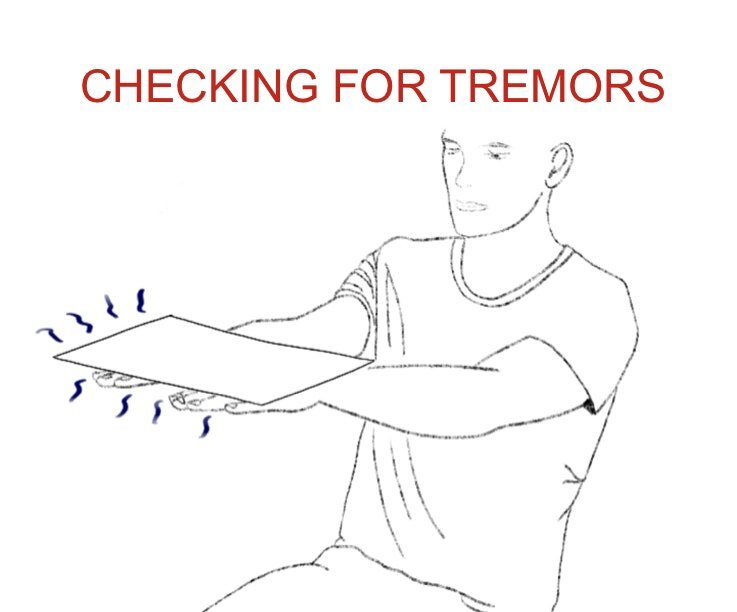
Check for hand tremor by asking the patient to extend their hands in front of them. Place a paper on top of the hands. Observe. If the paper is shaking, then they have tremor. Tremor is often found in hyperthyroidism.
The face
Observe the patient’s face in general for any dry skin or sweating.
Having thin eyebrows is one of the signs of hypothyroid (This is usually rare to see)
The eyes - inspection
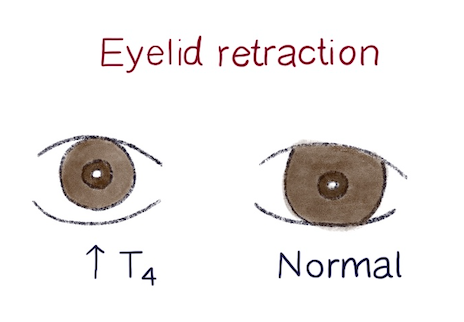
Check for lid retraction by standing in front of the patient and instruct them to look straight at you. Look at the sclera and observe if it is visible in the upper or lower eye margin.
Notice if the patient’s eye is bulging. This is known as exophthalmos.
Because of the lid retraction and the exophthalmos, the patient’s eyes are more prone to dryness. This can lead to conjunctivitis and later in severe cases, might result in corneal ulceration.
The eyes- examination
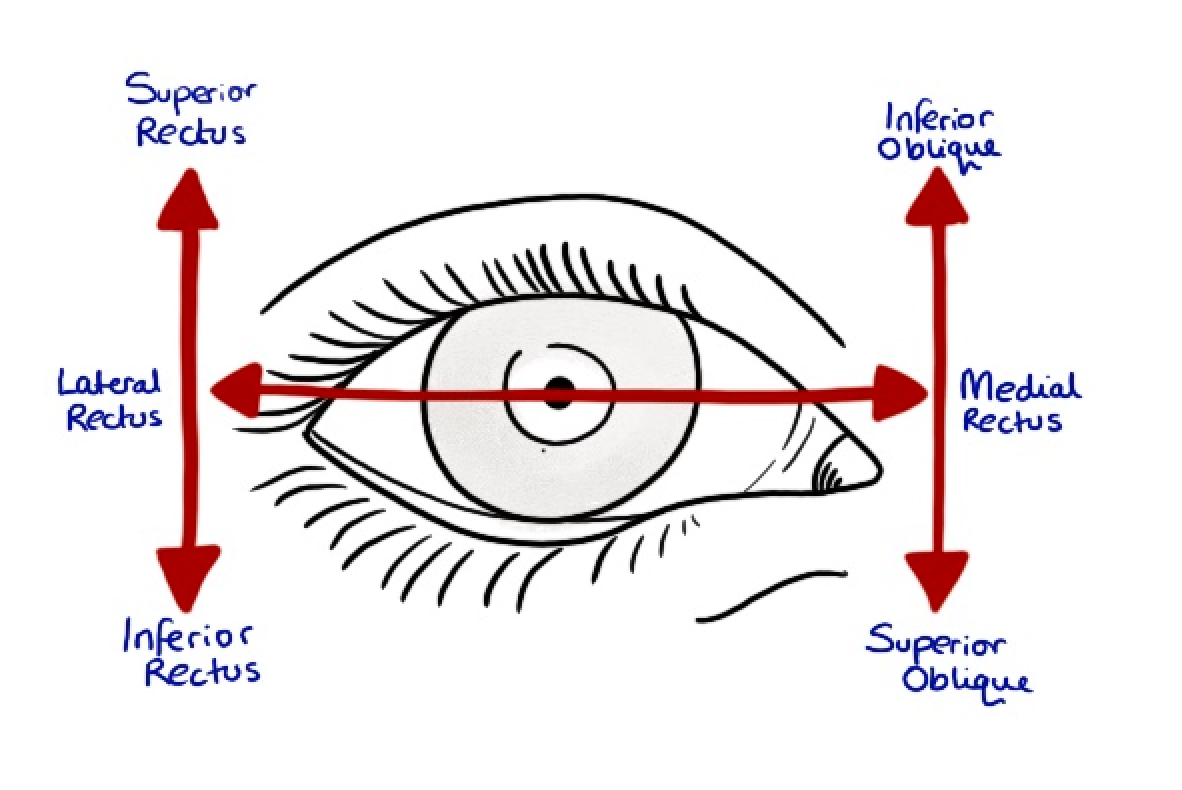
Examine the movements of the eyes - By sitting in front of the patient and asking them to keep their head still and only follow you finger with their eyes. Draw the letter “H” in front of the patient and instruct them to follow the “H”-shape with their eyes only (ensuring they keep their head still). Notice if there is any limitation in movement.
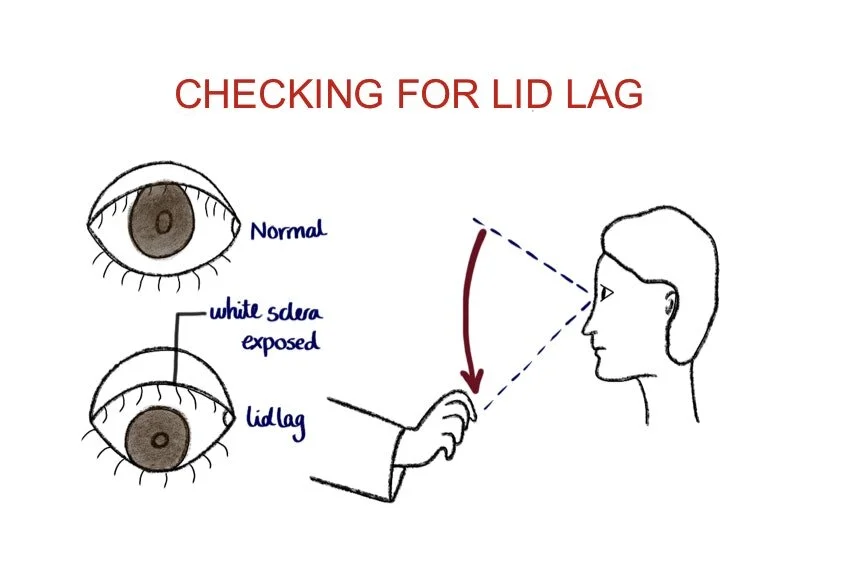
Check for lid lag: this is when the upper eyelid takes time on a downward movement.
Thyroid gland inspection
Stand in front of the patient - observe for the presence of any neck mass or scars that would indicate a past surgery.
A normal thyroid gland should not be visible.
In the presence of a neck swelling - note if it is bilateral, unilateral or diffuse.
Check for movement on deglutition (i.e. movement on swallowing) by giving the patient a glass of water and observing the movement of their neck as they swallow. Notice the movement of any mass. (Thyroid gland moves on swallowing, therefore, any mass located within the gland or attached to it will move as the patient swallows).
Check for the presence of a thyroglossal cyst by asking the patient to stick out their tongue. If the mass moves, this is more likely to be a thyroglossal cyst.
Thyroid gland palpation
Stand behind the patient and let them know you’ll be touching their neck to examine.
Use the fingers to gently feel the lobes of the gland. Do not palpate both sides at the same time. Alternate between the sides as to not make the patient uncomfortable.
Ask the patient to take a sip of water and swallow it. Feel the thyroid gland move against your fingers. Does it move symmetrically? If it is asymmetric movement, this may be because of enlargement of a single lobe or presence of a unilateral mass.
Ask the patient to protrude their tongue. Observe for any movement.
How to complete the examination
For thyroid examination to be complete, palpation of cervical lymph nodes should be done while you are still standing behind the patient.
Check that the trachea is centralised (in a unilateral thyroid swelling, the trachea may be pushed to the opposite side)
Auscultate for carotid bruit.
Assess the patient’s reflexes.
Tip: keep practicing till you can do it absentmindedly.
Thyroid examination is commonly asked in university OSCE’s and even in postgraduate OSCE’s. Many patients present to surgery with thyroid disease and knowing the correct steps to examine them and what to look for is vital.
Productivity tip - The Eisenhower Matrix
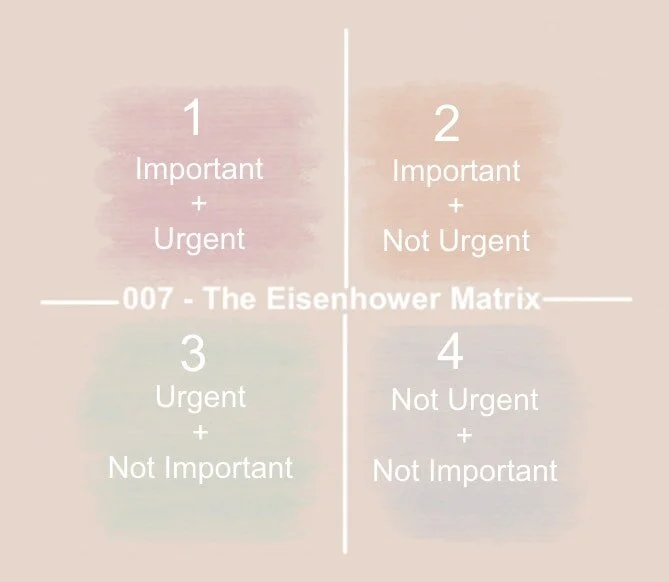
The Eisenhower Matrix (also known as the Urgent-Important Matrix) helps in prioritising tasks by urgency and importance and sorting out the less urgent and important tasks which can be delegated or cancelled.
Eisenhower was the 34th President of the United States. He served two terms from 1953 to 1961. He had had an incredible ability to sustain his productivity and his methods for managing time, managing tasks and productivity are widely studied by many.
The Eisenhower Matrix is his most famous productivity strategy and is a simple decision-making tool than can easily be used to prioritise your time.
Is the Eisenhower Matrix for you?
One of the reasons to try the Eisenhower Matrix is if you:
Find yourself continuously working and having deadlines
Are usually busy but not as productive as you want to be
Have long-term goals but no time or energy to make progress on them
Have a hard time delegating and/or saying no
How The Eisenhower Matrix works
1- Get a piece of blank paper and a pen (or you can use any device you like).
2- Write down all the things that you have to do, all your deadlines and tasks.
3- Draw lines to divide the paper into 4 sections and label each section as:
Important + Urgent = These tasks have a deadline approaching or they are tasks that cannot be delayed. If the task needs to be done within a day, or no longer than the next day, it is an urgent task and belongs in this category.
Important + Not urgent = These are tasks which are important, but not necessarily urgent. This could include a variety of responsibilities ranging from professional emails, follow-ups, to more personal appointments and commitments.
Urgent + Not important = This category refers to the tasks which are not important, but urgent. These activities can give the false sense of being important when in reality they have no contribution towards your productivity and may even delay more important tasks.
For tasks in this category, you can either postpone to another day or delegate them to someone else.
Not urgent + Not important = These tasks are major time wasters. They do not help you reach your goals and it is important to identify them and eliminate them from your productive days.
4- Sort every task and deadline that you initially wrote down into one of these four categories.
5- Now you have an idea of what your current priorities are and what the distractors (not urgent + not important) are.
Link: The Revision Card Series!
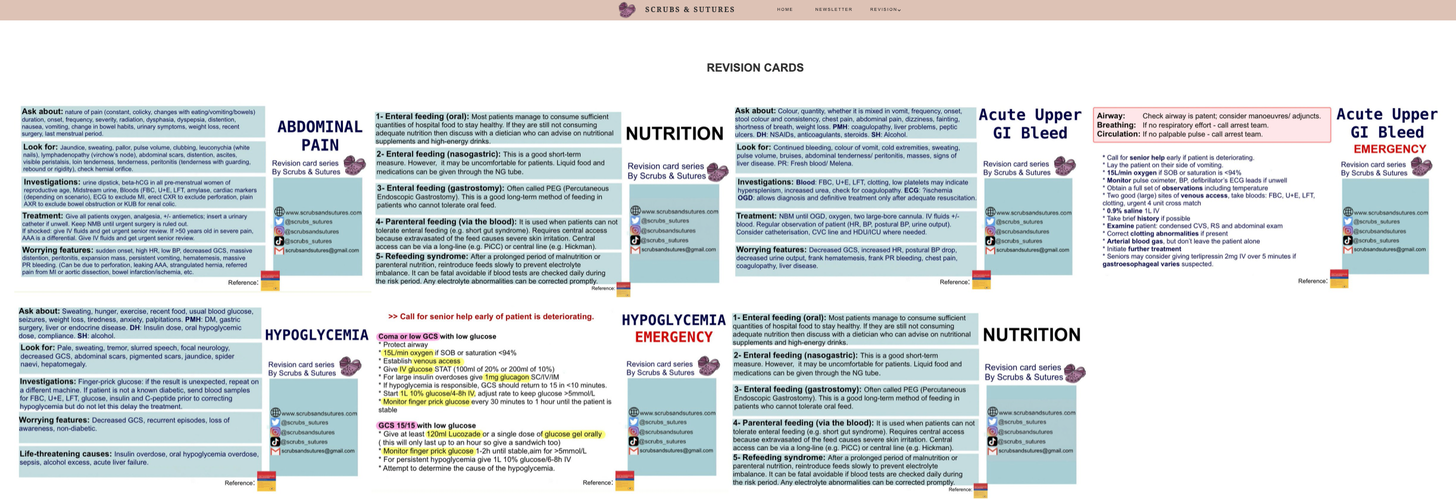
On Sunday I started a new Revision Card Series and the main aim is to provide revision cards that help medical students in their revision and also have a role in refreshing your knowledge if you are a doctor.
You can see them daily as they are released on my twitter account and you can check my website if you want to see them compiled in one place.
So far the Revision Card topics released were:
Abdominal pain
Nutrition
Stomas
Acute upper GI bleed
Acute upper GI bleed emergency (management)
Hypoglycaemia
Hypoglycaemia emergency (management)
Do you have any specific surgical topic that you want to read about next week? You can always make suggestions as I plan to make this newsletter as useful to you as possible. Feel free to contact me at scrubsandsutures@gmail.com or on twitter and I will try to tailor the next one for you.
Thank you for reading and stay tuned for more topics next week!
