
006 - New Year, New Plans

As a new year begins, we start a new 365-page book. In this week's newsletter 🧠 '006- New Year, New Plans'.
Topics covered are:
🩺 Breast examination
🩺 Carcinoid tumours
🌱 Personal development plan
Welcome to newsletter number 6!
If you're a returning reader, welcome back!
If you’re new, welcome! You can have a look at the previous posts so you don’t miss anything!
First and foremost, I would like to wish you all a happy new year!
The plan for this week's newsletter:
1- Skill: Breast examination
2- Surgical topic: Carcinoid tumors
3- Productivity tip: Writing a personal development plan
4- New discord channel!
Let’s begin!
Surgical skill: Breast Examination
1- Steps in breast examination
Patient preparation
Inspection
Palpation
Lymph node examination
2- Inspection
For breast inspection, there are three positions to take in consideration.
In all three positions, you should be looking for the presence of any scars, asymmetry, masses, nipple abnormalities and any skin changes.
A- First position : The patient should sit on the bed with their hands on their thighs. This is to relax the pectoral muscles.
B- Second position: The patient should press their hands into their hips to contract the pectoralis muscles. This manoeuvre may accentuate puckering if a mass is invading the suspensory ligaments of the breast is also tethered to the pectoralis muscle.
C- Third position: Ask the patient to place their hands behind their head and lean forward so that the breasts are pendulous. This position exposes the entire breast and will exaggerate any asymmetry, skin dimpling or puckering.
What kind of skin changes?
1- Check if the patient has any erythema of the breast tissue.
The causes of erythema include infection (e.g. mastitis or breast abscess), trauma (e.g. fat necrosis), underlying breast cancer.
2- Peau d’orange (dimpling of the skin resembling an orange peel).
This usually occurs due to cutaneous lymphatic oedema. The dimples represent tethering of the swollen skin to hair follicles and sweat glands.
Peau d’orange is typically associated with inflammatory breast cancer.
What kind of nipple changes?
1- Nipple inversion
Nipple inversion can be a normal finding in a significant proportion of women (e.g. congenital or weight-loss associated nipple inversion).
The possible pathological causes include: breast cancer, breast abscess, mammary duct ectasia and mastitis.
2- Nipple discharge
Is benign in most cases (e.g. pregnancy, breast-feeding). It can be associated with mastitis or underlying breast cancer.
3- Palpation
Position the patient as follows: head of the bed to 45° and ask the patient to lie down.
Palpate the asymptomatic breast first (this is to avoid any discomfort caused to the patient).
If a mass if found, describe the following: location of the mass, size, shape, consistency and mobility, fluctuance and if there are any palpable skin changes.
Make sure to palpate the axillary tail. This is because the majority of breast cancers develop in the upper outer quadrant, therefore, it is essential that this area is examined thoroughly.
Ensure to palpate the nipple-areolar complex. Inspect for any nipple discharge and if present, comment on the colour (e.g. blood-stained, green, yellow), the consistency (e.g. thick, watery) and the volume.
4- Axillary lymph node examination
In order to conclude breast examination, axillary lymph nodes should be palpated. The breast first drains into axillary lymph nodes, therefore, a breast pathology can cause enlarged axillary lymph nodes.
Surgical topic: carcinoid tumors
Definition: A slow-growing type of tumour usually found in the gastrointestinal system (most often in the small intestine and rectum), and sometimes in the lungs or other sites.
Carcinoid tumours arise from enterochromaffin cells (Kulchitsky cells of the crypts of Lieberkuhn) and are most commonly in the vermiform appendix.
Carcinoid tumour releases the following:
serotonin, bradykinins, prostaglandins, tachykinins, substance P and histamine.
Clinical presentation:
The patient may present with periodic abdominal pain.
They may present with manifestations of carcinoid syndrome as follows:
Cutaneous flushing
Diarrhoea and malabsorption
Cardiac manifestations: valvular heart lesions and fibrosis of the endocardium.
Wheezing or asthma-like syndrome, which occurs due to bronchial constriction
Investigations:
Chromogranin A (CgA) testing in the blood (protein secreted from carcinoid tumour cells)
5-hydroxyindolecetic acid (5-HIAA) testing in 24h urine (byproduct of serotonin)
Productivity tip: Writing a Personal Development Plan (PDP)
So, we’ve started a new year. We’ve already finished the first 7 days of a 365-page book. After today, 358 days are remaining in this year.
Many of us start the year with clear goals and expectations, new year resolutions, many go on to accomplish those goals and actually manage to stick to their resolutions.
We all have plans and dreams and a vision of a future we know we deserve and are willing to work hard for.
For the past couple of years, I’ve started learning about PDP and reading about this. In 2019 and 2020 I wrote a PDP and reviewed them in December. It showed me if I was accomplishing the goals I set for myself and whether I need to make any changes.
Therefore, I am writing a new one this year and planning to review it again in December 2021. We’ve had an unpredictable year, with lockdowns and exam cancellations, studying online and being away from friends and loved ones. It is important to have your goals in writing will always help guide you back to the right path when you feel lost.
So, how do we write a personal development plan?
Start with a blank sheet of paper and divide it in half. Write down your short-term goals (1-6 months) and long-term goals (6-12 months). All of these to be reviewed at the end of the year.
It depends on what kinds of goals you plan to achieve, you have to further divide them into things such as professional development and personal development.
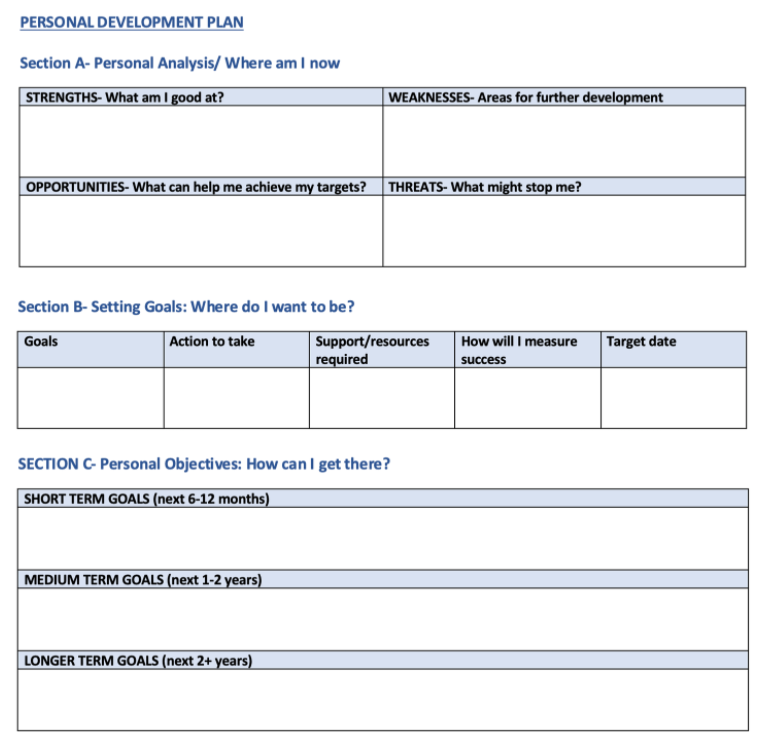
Below are some blank examples of what a PDP looks like, you can fill it and review your year later on.
New discord channel!
I’ve created a news discord channel! The aims is to provide support to medical students, foundation and core trainees during lockdown! At the moment we have one or two members but together we can form a community! Join and send the link to other medical students if you’re interested!
Have a look by clicking on this link https://discord.gg/hS98gcUw2A
Do you have any specific surgical topic that you want to read about next week? You can always make suggestions as I plan to make this newsletter as useful to you as possible. Feel free to contact me at scrubsandsutures@gmail.com or on twitter and I will try to tailor the next one for you.
I am happy to say that we’re a growing community. Still a small one but we have more than doubled within just a month.
If you like what you’re reading, recommend your friends to subscribe and it might be useful for them too!
We’ve reached the end of the newsletter!
Thank you for reading
Tune in next week for more!
