
008 - Getting Things Done

Topics discussed in this post:
🧠 Getting things done
🩺 Shock in a trauma patient
🔗 Teach me surgery
Welcome!
If you're a returning reader, welcome back!
If you’re new, welcome! You can have a look at the previous posts so you don’t miss anything!
The plan for this week's newsletter:
1- Productivity tip: Getting things done
2- Surgical topic: Shock in a trauma patient
3- Link/ app: Teach Me Surgery
Let's begin!
1- Productivity tip: Getting things done
Yesterday I completed reading the book “Getting things done without trying too hard” by Richard Templar. I found this to be an extremely useful book that gives an idea about how to keep on top of everything, multitasking and having a routine.
Below are a few of the useful points from the book that I have curated especially for this newsletter. (I also wrote a book summary - you can click HERE to read it if you are interested).
1- Have a routine
When you are really busy, the more of a routine you have, the easier your life becomes.
When you are a student, having a minimal routine is great and will always be useful. The busier your life gets the more essential a routine becomes in order to avoid forgetting important deadlines and always be at the top of your game.
The more routine you build into your life the easier it becomes to keep things on track.
2- Think positive
If you are dealing with a mountain of work, you are more likely to complete it faster when you are in a positive mindset.
Keep your focus on the things you have achieved so far, not on the things you haven’t completed yet.
In the end, all of your work will get done or the world will continue to go around without it if you haven’t.
Make sure to look on the bright side and keep in your mind what you have achieved. This helps set you in a positive mood and motivates you to do more.
3- Know when the good times are
Each one of us has their own productive time of the day. Many have said that this is most likely to be the same time you were born.
This timing can change as you progress through the years and vary depending on the different commitments that you have.
Try to track your attention and focus throughout your day for a couple of days and figure out which time of the day you are most focused. Once you figure that out, make sure you don’t lose that productivity window and schedule your study sessions/ work sessions at that time. This way you are more likely to complete your work faster and with a better quality.
4- Keep a notebook
This is a good habit to have.
If you keep a small notebook with you at all times (or a notes app on your phone - if that is what you prefer) - then you are more likely to jot important things down which you need to remember.
This way you are freeing up space in your brain for more important things and end up reducing your stress.
5- Read faster
We see so many friends, colleagues and social media influencers who say that have completed reading 30 books in a month or 50 books in a year and wonder “How do they do it?”. They speed-read.
Many of us read slowly, we read every word and move our eyes along the lines, getting to the end of the line and moving our eyes to the left to start a new line.
Fast readers barely move their eyes. They run them down the middle of the page and scan, looking for relevant information.
Try using this method and see how it works for you. Do you end up reading more books?
6- Plan your life
Have a plan for the long term. Then have a plan for the year ahead. With a plan you can see how you need to work towards it.
You should have a slightly more detailed plan for the next three months and a more detailed one for this month.
This is not a diary of appointments, this is your long-term checklist, to ensure that you are in the right track and whether you are working to achieve your goals or not.
7- Don’t read things you don’t need to
(Reading for pleasure is not included here).
Start by checking the contents page. Which chapters do you really need to read?
This is mostly a matter of your attitude. If you are the kind of person who feels they should read everything then you will feel guilty if you don’t.
8- Don’t give up
Perhaps this is the most important point. Not giving up on yourself is vital.
We can all get more things done if we decide to make it happen. Stick with it and you will find that you are achieving more and making less effort to do so.
It takes practice to use all these skills mindlessly and you need the right attitude. It might initially be hard work but if you stick with it you will eventually find that these habits and system become part of your daily life.
After completing this book, I would also like to add the following: Have a plan B. We are in a pandemic and things may not always go as planned. Exams and classes moved to virtual platforms, delays occurred and cancellations of courses. As long as you know what your ideal plan is (plan A) - you should also have a plan B - to avoid any stress you might face if things aren’t ideal.
2- Surgical topic: Shock in a trauma patient
Shock is an abnormality of the circulatory system that results in inadequate organ perfusion and tissue oxygenation.
Shock in a trauma patient is classified as hemorrhagic or non-hemorrhagic shock.
Initial determination of the cause of shock requires an appropriate patient history and careful physical examination.
Selected additional tests (chest and pelvic x-rays and focused assessment with sonography for trauma (FAST) examinations) can confirm the cause of shock, but should not delay appropriate resuscitation.
A- Hemorrhagic shock
Haemorrhage is an acute loss of circulating blood volume. It is the most common cause of shock after injury, and virtually all patients with multiple injuries have some degree of hypovolemia.
Sources of potential blood loss (chest, abdomen, pelvis, retroperitoneum, extremities, and external bleeding) must be quickly assessed by physical examination and appropriate adjunctive studies.
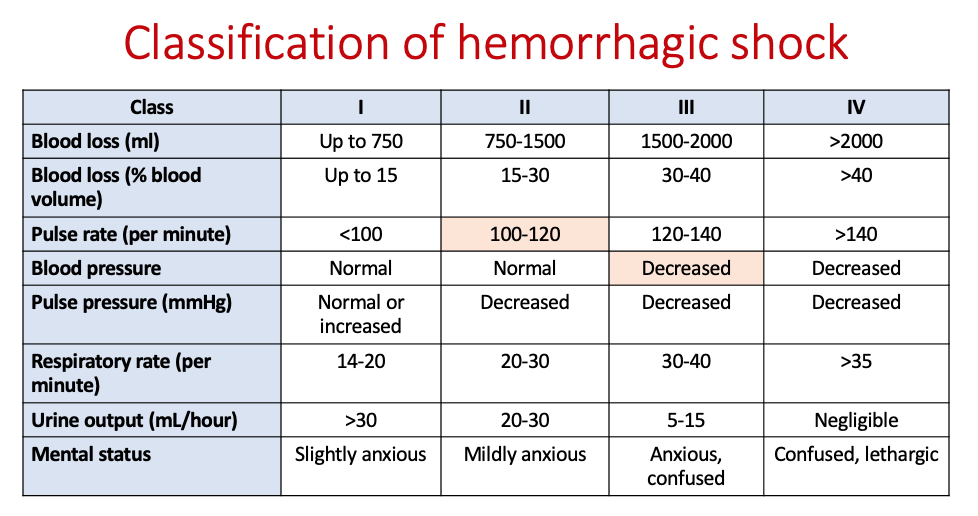
The physiologic effects of hemorrhage are divided into four classes, based on clinical signs, which are useful for estimating the percentage of acute blood loss.
The following classification system is useful in emphasising the early signs and pathophysiology of the shock state:
B- Non-hemorrhagic shock
Includes cardiogenic shock, cardiac tamponade, tension pneumothorax, neurogenic shock, and septic shock.
Cardiogenic shock
Myocardial dysfunction can be caused by blunt cardiac injury, cardiac tamponade, an air embolus, or, rarely, myocardial infarction.
All patients with blunt thoracic trauma need continuous electrocardiographic (ECG) monitoring to detect injury patterns and dysrhythmias
Cardiac enzyme levels may assist in diagnosing and treating injured patients in the emergency department (ED), as acute myocardial ischemia may be the precipitating event.
Cardiac tamponade
Most commonly encountered in patients with penetrating thoracic trauma (can also result from blunt injury to the thorax)
Tachycardia, muffled heart sounds, and dilated, engorged neck veins with hypotension and insufficient response to fluid therapy suggest cardiac tamponade.
Echocardiography may be useful in diagnosing tamponade and valve rupture, but it is often not practical or immediately available in the ED.
FAST performed in the ED can identify pericardial fluid, which suggests cardiac tamponade as the cause of shock.
Cardiac tamponade is best managed by formal operative intervention, as pericardiocentesis is at best only a temporising manoeuvre.
Neurogenic shock
Isolated intracranial injuries do not cause shock, unless the brainstem is injured.
A narrowed pulse pressure is not seen in neurogenic shock.
Septic shock
Shock due to infection immediately after injury is uncommon; however, it can occur when a patient’s arrival at the ED is delayed for several hours.
Can occur in patients with penetrating abdominal injuries and contamination of the peritoneal cavity by intestinal contents.
Key points
Shock is an abnormality of the circulatory system that results in inadequate organ perfusion and tissue oxygenation.
Hemorrhage is the cause of shock in most trauma patients. Treatment of these patients requires immediate hemorrhage control and fluid or blood replacement. Stop the bleeding.
Management of hemorrhagic shock includes rapid hemostasis and balanced resuscitation with crystalloids and blood.
The classes of hemorrhage serve as a guide to resuscitation.
3- Link: Teach Me Surgery
This website is great for medical students and junior doctors. It is good for brushing up your knowledge and is easy to use.
It has a variety of surgical topics including surgical skills, common surgery patient presentations and great explanatory videos.

Do you have any specific surgical topic that you want to read about next week? You can always make suggestions as I plan to make this newsletter as useful to you as possible. Feel free to contact me at scrubsandsutures@gmail.com or on twitter and I will try to tailor the next one for you.
Thank you for reading and stay tuned for more topics next week!
