
010- Study Tips
Topics discussed in this post:
🧠Study tips
📚Revision card: Anaphylaxis
🔗 Interesting link
Welcome!
If you're a returning reader, welcome back!
If you’re new, welcome! You can have a look at the previous posts so you don’t miss anything!
Studying tips
As a medical student (or a trainee), you will notice that your study techniques might continuously change throughout time regardless of what level you are at. You might find some subjects need to be understood (like physiology) while others have a large aspect of memorisation (anatomy!). You have to be flexible enough to notice this needed variation in study technique and tailor your effort accordingly.
The amount of time you spend studying will always depend on whether you have exams or not, and how many hours a day you spend attending lectures or being in the hospital.
You can see a few different study techniques that medical students use and you may have heard of all of them, one of them or none of them!
1- Initial reading
The first time you read a topic, many are likely to spend a long time trying to understand it. Memorising information without having a deeper understanding is likely to result in a higher chance of you forgetting it.
The first time you read your lecture / book, take a little bit more time. This works if you don’t have an upcoming exam and are not pressed for time.
In your initial reading session, you can write summary points of what you have read, This way you won’t have to re-read the lecture/book and can rely on your own summary.
2- Using flashcards
The majority of medical student use flashcards.
Whether you chose to have physical cards or use apps such as Anki, study cards are quite important and effective.
Using study cards/ Anki helps in spaced repetition and usually works for subjects that require a high level of memorisation. They help in learning information and the more you repeat them the better the chance it is to convert that information from short-term to long-term memory.
3- Minimise non-productive studying
If you are listening to a recorded lecture, it might be a good idea to increase the speed. For example, many lectures have periods of pause or periods where the information given is not essential or there are side discussions.
When listening to your lectures, you can always increase the speed when you reach the quieter/slower parts. If the lecturer starts explaining something important or the information becomes more dense, then you can pause the lecture or listen to it at the normal speed in order to make sure you can understand what is being explained and write your own notes.
Passively listening to the same lecture over and over again will not result in you memorising the relevant information and you might find yourself having a difficult time during assessment or when you are with a patient.
It helps to write notes, or if that is not a method that you prefer, then try to spend time reflecting on what you have listened to in the lecture and further clarifying anything that you haven’t understood.
4- Mnemonics
Mnemonics are great. They helped me throughout medical school and always come in handy when you’re in the hospital taking history from patients and coming up with a differential diagnosis.
They have an important role in forming memory when used correctly but if overused can result in confusion.
For any topic that you are studying, it is a good idea to come up with a mnemonic if you are unable to memorise the information.
If you are unable to come up with a mnemonic you can always just search online for a mnemonic of that particular topic.
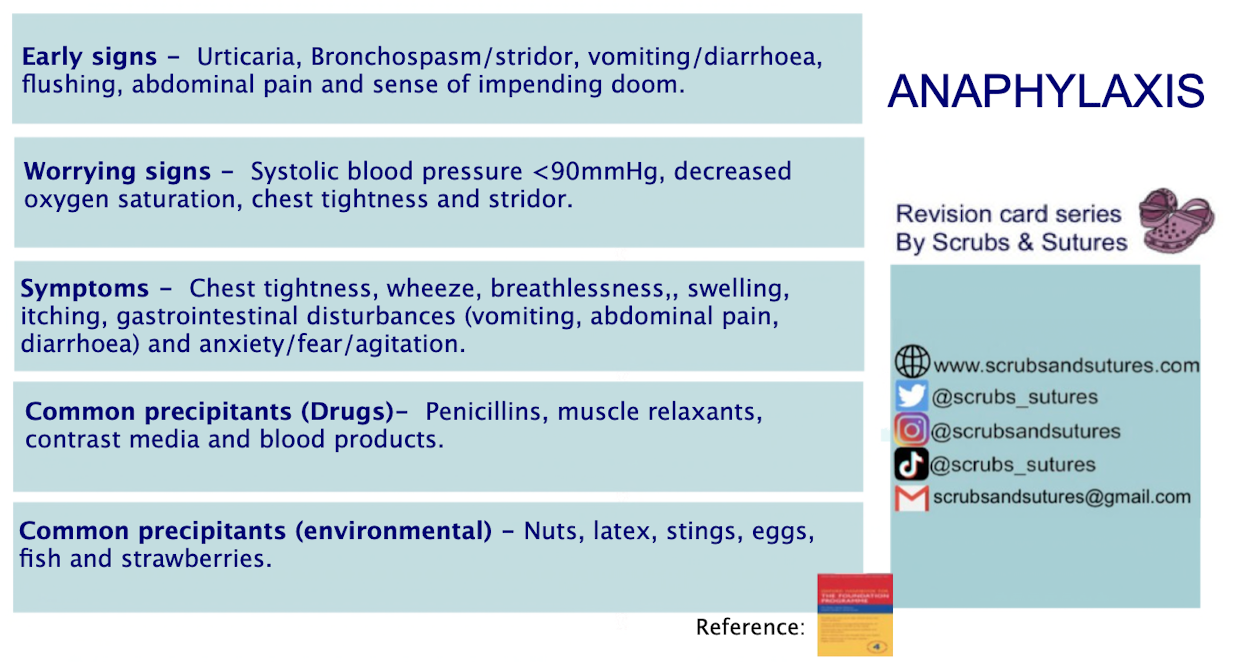
Revision card of the week: Anaphylaxis
Interesting website: Orthopaedics
This week I came a cross a very good website that helps with orthopaedics.
It gives good, reliable concise information about orthopaedics, including clinical cases, questions and common conditions that are usually seen in the clinic or in theatre.
Have a look at the link below!

Do you have any specific surgical topic that you want to read about next week? You can always make suggestions as I plan to make this newsletter as useful to you as possible. Feel free to contact me at scrubsandsutures@gmail.com or on twitter and I will try to tailor the next one for you.
Thank you for reading and stay tuned for more topics next week!
